


Table of Contents
- Methanol Specifications and Key Properties
- What Are the Main Industrial Methanol Uses?
- 1. Chemical Manufacturing
- 2. Fuel and Energy Applications
- 3. Pharmaceutical and Fine Chemical Manufacturing
- 4. Laboratory and Analytical Applications
- 5. Selected Solvent and Industrial Processing Applications
- Why Is Methanol Used in Industrial Processes?
- How to Select the Right Methanol Grade
- Methanol Safety and Handling Requirements
- Conclusion
- What are the main methanol uses?
- Is methanol used as an industrial solvent?
- What is the chemical formula of methanol?
- Is methanol suitable for pharmaceutical manufacturing?
- What should buyers check before purchasing methanol?
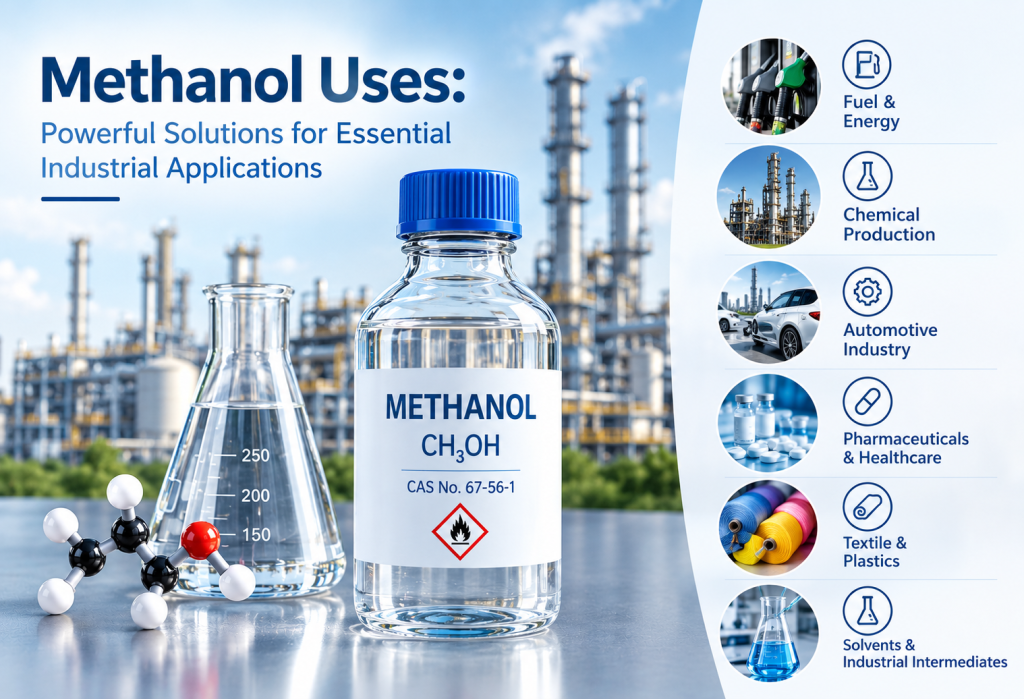
Methanol Uses span chemical manufacturing, fuel production, laboratory analysis, and selected industrial processes. Methanol (CH₃OH), also known as methyl alcohol, is a colorless, volatile, and highly flammable liquid used mainly as a chemical feedstock and, in specific applications, as a solvent.
Understanding methanol properties, industrial applications, and safety requirements helps manufacturers select suitable grades for their processes. This guide explains the major methanol applications, its technical characteristics, and the factors industrial buyers should evaluate before sourcing this chemical.
Methanol Specifications and Key Properties
| Property | Typical Value |
|---|---|
| Chemical name | Methanol |
| Synonyms | Methyl alcohol, wood alcohol |
| Chemical formula | CH₃OH |
| CAS number | 67-56-1 |
| Molecular weight | 32.04 g/mol |
| Appearance | Clear, colorless liquid |
| Boiling point | Approximately 64.7°C at 101.3 kPa |
| Flash point | Approximately 11°C, closed cup; method-dependent |
| Density | Approximately 0.792 g/cm³ at 20°C |
| Water solubility | Miscible in all proportions |
Values are typical reference data and may vary slightly with test method and product specifications. Buyers should verify the current technical data sheet and certificate of analysis for the supplied grade.
What Are the Main Industrial Methanol Uses?
1. Chemical Manufacturing
One of the most significant Methanol Uses is as a feedstock for manufacturing other chemicals. Methanol is converted into compounds that serve as building blocks for plastics, resins, adhesives, and numerous industrial materials.
- Formaldehyde: Used in the production of resins, engineered wood products, and other chemical materials.
- Acetic acid: Methanol is used in established industrial processes to manufacture acetic acid.
- Methyl derivatives: It is a feedstock for products such as methylamines and methyl esters.
- Other chemical intermediates: Methanol supports processes used to produce a range of downstream chemicals.
Demand for methanol in these applications depends on downstream manufacturing capacity, process economics, and regional chemical markets.
2. Fuel and Energy Applications
Methanol is used in certain fuel applications and can serve as a feedstock for producing other fuels and energy-related chemicals. Depending on the technology and regulatory framework, its applications include:
- Selected fuel blends and specialized fuel systems
- Production of dimethyl ether (DME)
- Methanol-to-gasoline and other conversion technologies
- Research and development involving alternative fuels
Fuel use requires suitable specifications, compatible equipment, and appropriate controls. Methanol’s toxicity, flammability, and material compatibility must be considered during storage, transport, and handling.
3. Pharmaceutical and Fine Chemical Manufacturing
Methanol can be used as a process solvent, extraction medium, or chemical reagent in selected pharmaceutical and fine chemical operations. Its suitability depends on the manufacturing process, purity requirements, and the ability to control residual solvent levels.
Because methanol presents significant toxicity concerns, pharmaceutical manufacturers must follow applicable quality requirements and validated procedures. It is classified as a Class 2 solvent in the ICH Q3C residual-solvents guideline, meaning its use should be limited and controlled according to the relevant guidance.
Reference: ICH Quality Guidelines.
4. Laboratory and Analytical Applications
Another important area among Methanol Uses is laboratory analysis. Appropriate grades of methanol are used in analytical methods, sample preparation, and chromatography.
- High-performance liquid chromatography (HPLC)
- Preparation of analytical solutions
- Selected extraction and sample preparation procedures
- Chemical research and instrumental analysis
Analytical work may require HPLC-grade or other specified purity levels. Industrial-grade methanol should not be substituted for a laboratory grade unless the method and its specifications permit it.
5. Selected Solvent and Industrial Processing Applications
Methanol dissolves water and many organic compounds, making it useful in selected chemical processing and formulation operations. Its relatively low boiling point can also support processes requiring easy solvent removal.
However, methanol is not a universal replacement for conventional paint, coating, or cleaning solvents. Its toxicity, evaporation behavior, and compatibility with the formulation must be assessed before use. For broader solvent-selection guidance, see our overview of industrial solvents.
Why Is Methanol Used in Industrial Processes?
The value of methanol comes from a combination of chemical reactivity and physical properties. It is miscible with water, has a relatively low boiling point, and serves as a versatile feedstock for several large-scale chemical processes.
- Chemical versatility: Supports the production of numerous downstream chemicals.
- Water miscibility: Useful in processes that require mixing with aqueous systems.
- Volatility: Allows recovery or removal under suitable process conditions.
- Industrial availability: Established production and distribution networks support many manufacturing sectors.
These characteristics do not mean methanol is suitable for every application. Process performance, exposure controls, equipment compatibility, and the cost of safe handling should be evaluated together.
How to Select the Right Methanol Grade
When evaluating Methanol Uses for a specific production process, industrial buyers should match the product grade to the intended application rather than relying on the chemical name alone.
- Purity: Check the required methanol concentration and limits for water and other impurities.
- Application requirements: Confirm whether the process needs industrial, reagent, or analytical-grade material.
- Documentation: Request a technical data sheet (TDS), safety data sheet (SDS), and certificate of analysis (CoA).
- Packaging and logistics: Confirm suitable containers, transport arrangements, and storage conditions.
- Supplier reliability: Evaluate specification consistency, traceability, availability, and technical support.
To review available chemicals, visit the Aasad Chimie products page. For product specifications and sourcing inquiries, you can also contact Aasad Chimie.
Methanol Safety and Handling Requirements
Methanol is highly flammable and toxic if swallowed, inhaled, or absorbed through the skin. Exposure can cause serious health effects, including damage to the optic nerve, blindness, and death. Its risks must never be underestimated simply because it is a common industrial chemical.
Industrial facilities should use suitable ventilation, compatible closed-transfer systems where appropriate, proper protective equipment, and approved storage arrangements. Keep methanol away from ignition sources and follow the product safety data sheet, workplace exposure controls, and applicable transport regulations.
For chemical hazard classification and communication principles, consult the United Nations Globally Harmonized System (GHS).
Conclusion
Methanol Uses include chemical feedstock production, selected fuel technologies, pharmaceutical processing, laboratory analysis, and specialized solvent applications. Its low boiling point, water miscibility, and chemical reactivity make it valuable across multiple industries, but suitability depends on grade, process conditions, and safety controls.
Before purchasing methanol, verify the required purity, technical documentation, and handling procedures. Visit Aasad Chimie products or contact the team to discuss your industrial chemical requirements.
What are the main methanol uses?
Methanol is primarily used as a chemical feedstock for products such as formaldehyde and acetic acid. Other applications include selected fuel technologies, laboratory analysis, and specialized industrial processes.
Is methanol used as an industrial solvent?
Yes. Methanol is used as a solvent in selected industrial and laboratory processes. Its toxicity and flammability must be considered when determining whether it is suitable for a particular application.
What is the chemical formula of methanol?
The chemical formula of methanol is CH₃OH, and its CAS number is 67-56-1.
Is methanol suitable for pharmaceutical manufacturing?
Methanol may be used in controlled pharmaceutical manufacturing processes, but its use and residual levels must comply with applicable quality requirements. It is classified as a Class 2 solvent under ICH Q3C guidance.
What should buyers check before purchasing methanol?
Buyers should verify purity, grade, certificate of analysis, safety data sheet, packaging, supplier reliability, and suitability for the intended process.