


Table of Contents
- Quick Answer: How Can You Reduce PP Extrusion Defects?
- Why Extrusion Defects Matter in Polypropylene Manufacturing
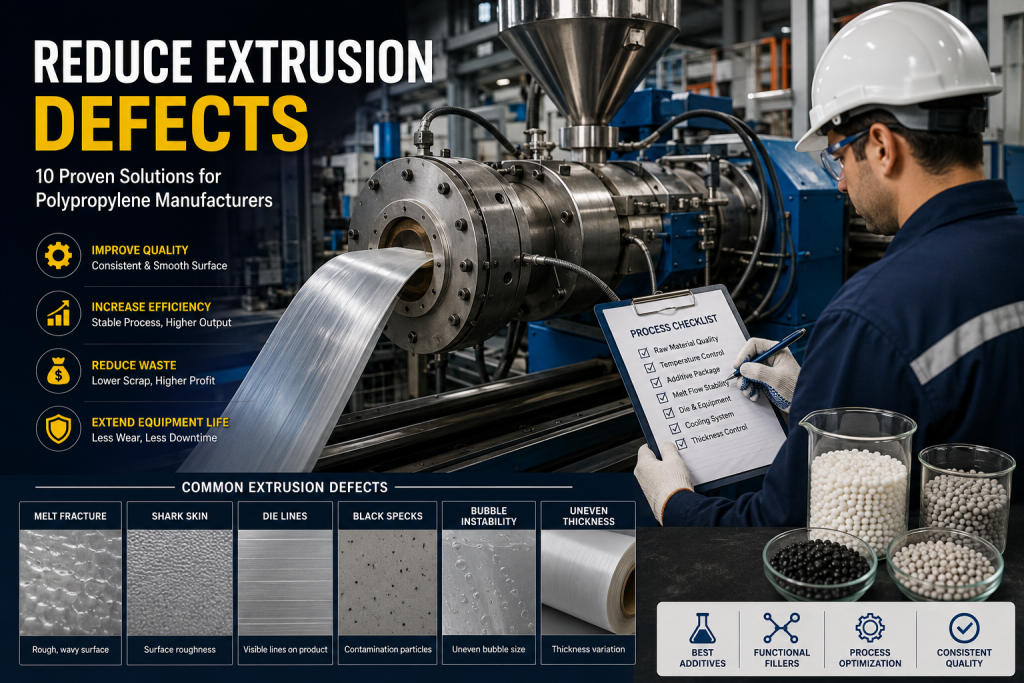
- Common Types of PP Extrusion Defects
- 10 Ways to Reduce PP Extrusion Defects
- 1. Improve Raw Material Quality
- 2. Optimize Processing Temperature
- 3. Evaluate Compatible Processing Additives
- 4. Improve Filler Dispersion
- 5. Monitor Melt Flow Consistency
- 6. Maintain Extrusion Equipment
- 7. Select Compatible Polymer Additives
- 8. Improve Material Handling and Storage
- 9. Optimize Production Parameters
- 10. Work with an Experienced Material Supplier
- How to Troubleshoot Extrusion Defects Systematically
- Supporting Resources for Better Extrusion Performance
- Conclusion
- References
- What are the most common PP extrusion defects?
- How can manufacturers reduce extrusion defects?
- Can processing additives prevent extrusion defects?
- Why do black specks appear in polypropylene extrusion?
- How does filler dispersion affect extrusion quality?
PP Extrusion Defects can increase material waste, reduce production efficiency, and affect the quality of polypropylene products. Common problems include rough surfaces, melt fracture, die build-up, black specks, and inconsistent dimensions. Manufacturers can reduce these issues by optimizing processing conditions, improving material handling, maintaining equipment, and selecting compatible additives.
These solutions apply to polypropylene extrusion processes used for woven bags, raffia tapes, films, pipes, sheets, and other plastic products. The correct approach depends on the defect, resin grade, equipment configuration, and finished-product specifications.
Quick Answer: How Can You Reduce PP Extrusion Defects?
To reduce PP extrusion defects, select consistent raw materials, optimize processing temperatures, maintain stable melt flow, improve filler dispersion, use compatible additives, prevent contamination, and monitor equipment performance. Identify the root cause of each defect before changing the formulation or production settings.
Why Extrusion Defects Matter in Polypropylene Manufacturing
Extrusion defects can increase scrap rates, cause unplanned downtime, reduce production output, and create quality issues for customers. Effective defect prevention can help manufacturers achieve:
- Lower material waste and rejection rates
- More consistent surface quality
- Better dimensional control
- More stable production conditions
- Reduced unplanned maintenance
- Improved manufacturing efficiency
- More consistent finished-product quality
Common Types of PP Extrusion Defects
| Defect | Possible Cause | Recommended Check |
|---|---|---|
| Melt fracture | Excessive shear stress or unsuitable processing conditions | Review throughput, die design, and melt temperature |
| Sharkskin | High shear stress near the die wall | Evaluate die conditions and processing parameters |
| Die build-up | Material deposits or degradation products | Inspect die surfaces, temperature settings, and material compatibility |
| Black specks | Contamination or degraded polymer | Check raw materials, filters, and equipment cleanliness |
| Uneven thickness | Unstable output, die-flow variation, or cooling problems | Check feeding, die gaps, pressure, and haul-off speed |
| Film bubbles or instability | Unstable air pressure, cooling, or melt strength | Review bubble control and cooling conditions |
10 Ways to Reduce PP Extrusion Defects
1. Improve Raw Material Quality
Consistent raw materials help maintain predictable processing behavior. Variations in resin grade, contamination, or inconsistent material properties can cause unstable extrusion and defects in the finished product.
Check supplier specifications, batch consistency, material identification, and incoming quality records. Use the polypropylene grade recommended for the intended application and verify that any alternative grade meets the required mechanical and processing specifications.
2. Optimize Processing Temperature
Incorrect temperature settings can affect melt viscosity, pressure, surface appearance, and polymer stability. Low temperatures may contribute to excessive pressure or poor melt homogeneity, while excessive heat or long residence times may cause degradation.
Establish a suitable barrel temperature profile based on the resin manufacturer’s recommendations, equipment design, and production conditions. Monitor actual melt temperature where possible and avoid making large adjustments without validating their effects.
3. Evaluate Compatible Processing Additives
Selected processing additives can help improve processing stability, manage friction, or reduce specific surface defects. Their effectiveness depends on the additive chemistry, dosage, polypropylene grade, and extrusion conditions.
Test additives under controlled production conditions and compare extrusion pressure, output, surface quality, and scrap rates. Do not assume that every additive improves every defect.
Read our guide to plastic processing additives for more information about their applications in polymer manufacturing.
4. Improve Filler Dispersion
Poor filler dispersion can create agglomerates, uneven surfaces, inconsistent mechanical properties, and processing instability. These problems may be particularly noticeable when mineral fillers are used in polypropylene compounds.
Review filler compatibility, masterbatch quality, feeding consistency, mixing conditions, and screw configuration. Validate any formulation changes through testing to ensure that the filler improves the intended properties without creating additional defects.
Explore our guides to functional fillers and advanced functional filler powder.
5. Monitor Melt Flow Consistency
Changes in melt flow behavior can contribute to unstable extrusion, inconsistent dimensions, and surface defects. Melt Flow Rate (MFR), commonly called Melt Flow Index (MFI) in industry, helps manufacturers compare the flow behavior of thermoplastics under specified test conditions.
Monitor MFR according to the relevant test method and compare results with the resin specification. Also track melt pressure, output rate, temperature, and product dimensions because MFR alone cannot explain every processing problem.
Learn more about improving melt flow in polypropylene.
6. Maintain Extrusion Equipment
Worn screws, contaminated dies, blocked screen packs, and inaccurate temperature sensors can contribute to pressure fluctuations and inconsistent output. Regular maintenance helps identify these problems before they cause extended downtime or rejected products.
Recommended maintenance checks include:
- Inspecting and cleaning dies according to equipment procedures
- Checking screen packs and melt filters for blockage
- Inspecting screws and barrels for wear
- Verifying temperature sensors and controllers
- Monitoring melt pressure and pressure fluctuations
- Checking cooling systems and material feeding equipment
Follow the equipment manufacturer’s maintenance procedures and document recurring faults to identify patterns.
7. Select Compatible Polymer Additives
Processing aids, lubricants, antioxidants, and stabilizers serve different functions in polymer formulations. The wrong additive or an unsuitable dosage can create compatibility issues, affect product properties, or fail to address the actual cause of a defect.
Choose additives according to the material grade, processing method, and intended end use. Conduct compatibility and performance testing before introducing formulation changes into full-scale production.
Our resource on polymer processing chemicals provides additional information about specialty materials used in polymer production.
8. Improve Material Handling and Storage
Dust, foreign particles, and degraded material can contribute to black specks, contamination, and inconsistent product appearance. Effective material handling helps protect resin quality throughout storage and production.
Follow these practices:
- Store resin and additives in clean, suitable conditions
- Keep packaging sealed until the material is needed
- Inspect incoming materials for contamination or damage
- Clean hoppers, conveying lines, and feeding equipment
- Use drying procedures when required by the material specification
- Prevent cross-contamination between different grades and colors
Polypropylene does not generally require routine drying under all circumstances. Follow the resin supplier’s instructions and investigate moisture or contamination when process symptoms indicate a problem.
9. Optimize Production Parameters
Screw speed, feed rate, melt temperature, die conditions, cooling, and haul-off speed interact during extrusion. Changing one setting without considering the others may solve one issue while creating another.
| Parameter | What to Monitor |
|---|---|
| Screw speed | Output stability and melt pressure |
| Melt temperature | Flow behavior and signs of degradation |
| Material feed rate | Consistent material supply |
| Cooling conditions | Dimensional stability and product shape |
| Haul-off speed | Thickness and dimensional variation |
| Die conditions | Surface quality and flow uniformity |
Establish validated operating ranges for each product and record successful production settings. Use controlled trials to confirm that adjustments reduce defects without compromising quality.
10. Work with an Experienced Material Supplier
A reliable supplier can provide technical data, consistent materials, application guidance, and assistance with troubleshooting. This support is especially valuable when a defect may be related to resin selection, filler loading, or additive compatibility.
Before switching suppliers or formulations, compare technical specifications and conduct production trials. Evaluate the total cost of acceptable finished products rather than focusing exclusively on the purchase price of raw materials.
To explore available materials, visit the AasadChimie products page or contact our team for product-related inquiries.
How to Troubleshoot Extrusion Defects Systematically
A structured troubleshooting process can help manufacturers identify the cause of defects more efficiently.
- Describe the defect and record when it first appeared.
- Check whether the problem affects all products or only a specific resin batch.
- Review recent changes to material, additives, temperature, screw speed, and output.
- Inspect filters, dies, feeding systems, and relevant equipment components.
- Change one variable at a time where practical and record the result.
- Confirm the solution through repeat production and quality testing.
Documenting the defect, likely cause, corrective action, and final result helps operators respond consistently if the problem occurs again.
Supporting Resources for Better Extrusion Performance
Extrusion quality depends on material selection, process control, and equipment condition. Our articles on calcium carbonate filler masterbatch and functional fillers explain formulation considerations for filled polypropylene compounds.
You can also review plastic processing additives and polypropylene melt flow optimization for further troubleshooting guidance.
Conclusion
Reducing PP Extrusion Defects requires a systematic approach to raw material selection, temperature control, melt flow monitoring, filler dispersion, equipment maintenance, and production parameter optimization. The best solution depends on the specific defect and the conditions under which it occurs.
By identifying root causes, testing changes carefully, and monitoring finished-product quality, polypropylene manufacturers can reduce waste, improve production consistency, and make better use of raw materials. Consistent process records and supplier technical support can further strengthen long-term manufacturing performance.
For material information, explore AasadChimie products or contact AasadChimie.
References
What are the most common PP extrusion defects?
Common defects include melt fracture, sharkskin, die build-up, black specks, uneven thickness, and unstable film bubbles. The causes may include unsuitable processing conditions, contamination, or equipment problems.
How can manufacturers reduce extrusion defects?
Manufacturers can improve raw material consistency, optimize processing temperatures, monitor melt pressure, maintain equipment, and test compatible additives to address specific defects.
Can processing additives prevent extrusion defects?
Some processing additives can help reduce specific surface defects or improve processing stability. Their effectiveness depends on the additive type, formulation, resin grade, and operating conditions.
Why do black specks appear in polypropylene extrusion?
Black specks may result from degraded polymer, contaminated raw materials, deposits inside the equipment, or contamination in filters and conveying systems. Inspection and systematic troubleshooting help identify the source.
How does filler dispersion affect extrusion quality?
Poor filler dispersion can cause agglomerates, surface imperfections, inconsistent mechanical properties, and unstable processing. Appropriate filler selection and controlled compounding help improve consistency.