


Table of Contents
- What Is an Industrial Solvent?
- Common Types of Industrial Solvents
- Key Factors in Solvent Selection
- 1. Solvency and Cleaning Performance
- 2. Evaporation Rate and Drying Time
- 3. Material and Equipment Compatibility
- 4. Safety and Workplace Exposure
- 5. Total Operating Cost
- Solvent Selection for Different Industries
- Paints and Coatings
- Metal Cleaning and Surface Preparation
- Adhesives and Sealants
- Printing and Packaging
- Electronics and Precision Cleaning
- How to Compare Industrial Solvents
- Environmental Considerations and Solvent Recovery
- Common Mistakes in Solvent Selection
- A Practical Solvent Selection Checklist
- Where to Source Industrial Solvents
- Conclusion
- What is solvent selection in manufacturing?
- What factors should manufacturers compare when choosing a solvent?
- How does evaporation rate affect solvent performance?
- Can one solvent be used for every industrial application?
- How can manufacturers reduce solvent-related costs?
- What documents should buyers request from a supplier?
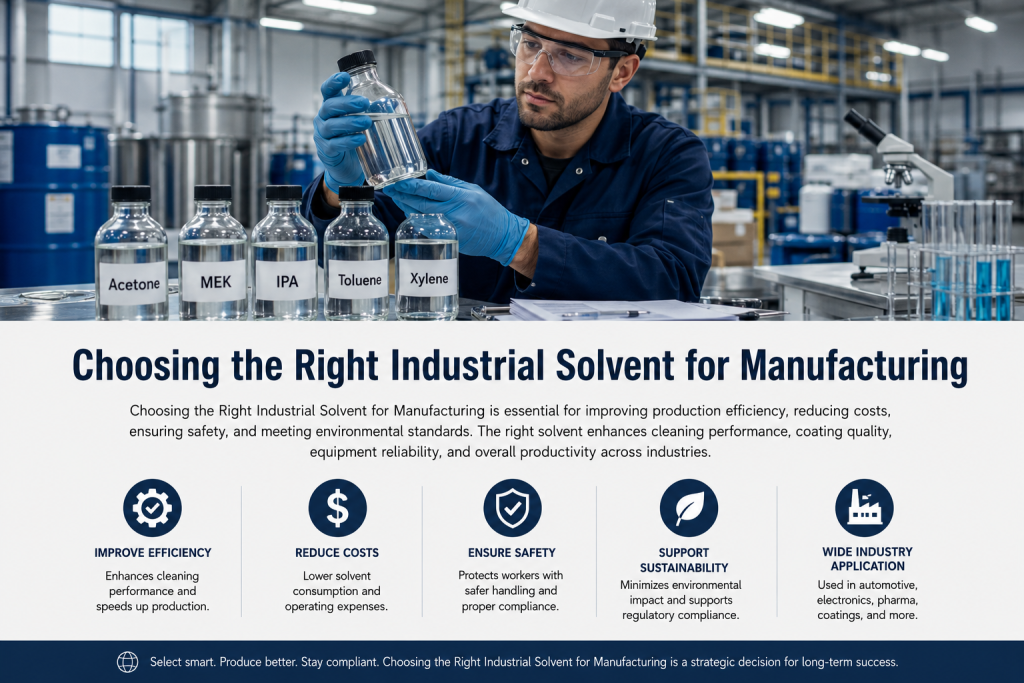
Solvent selection helps manufacturers improve cleaning efficiency, coating performance, production consistency, and operating costs. Choosing the right industrial solvent depends on the target material, required solvency, evaporation rate, equipment compatibility, and workplace safety requirements.
This guide explains how solvent selection works, which properties manufacturers should compare, and how to choose a suitable product for different industrial applications. It also covers safety, environmental considerations, and total operating costs.
What Is an Industrial Solvent?
An industrial solvent is a liquid used to dissolve, dilute, extract, or remove another substance during manufacturing. These chemicals are widely used in paints, coatings, adhesives, printing inks, chemical processing, metal cleaning, and surface preparation.
Depending on its chemical properties, a solvent can dissolve resins, reduce formulation viscosity, remove oils and grease, or prepare surfaces for further treatment. Effective solvent selection matches the chemical characteristics of a product to the requirements of the manufacturing process.
Common Types of Industrial Solvents
Different solvent families provide different levels of solvency, evaporation, and material compatibility. Understanding these differences helps manufacturers narrow down suitable candidates before conducting production trials.
| Solvent type | Examples | Typical applications | Key consideration |
|---|---|---|---|
| Ketones | Methyl ethyl ketone (MEK), acetone | Coatings, adhesives, cleaning, and resin processing | Solvency and evaporation rate |
| Alcohols | Isopropyl alcohol (IPA), ethanol | Surface cleaning, inks, and formulation processes | Polarity, water content, and residue |
| Aromatic hydrocarbons | Toluene, xylene | Paints, coatings, and selected resin systems | Compatibility, exposure controls, and emissions |
| Esters | Ethyl acetate, butyl acetate | Coatings, inks, and adhesives | Drying profile and formulation compatibility |
| Glycol ethers | Selected glycol ether grades | Specialty cleaners, coatings, and formulated products | Solvency, drying time, and hazard profile |
These examples are general starting points rather than interchangeable recommendations. Verify the exact solvent grade, formulation requirements, Safety Data Sheet (SDS), and compatibility with the materials being processed.
Key Factors in Solvent Selection
1. Solvency and Cleaning Performance
Solvency describes a solvent’s ability to dissolve a target substance. The appropriate product depends on the chemical nature of the material being removed or processed, such as oil, grease, resin, ink, adhesive, or coating residue.
A solvent that works well for one resin or contaminant may perform poorly with another. Test candidate products under actual operating conditions and assess cleaning efficiency, dissolution rate, residue, and final surface quality. These tests provide practical evidence for a reliable solvent selection decision.
For more information about individual products, read our guides to MEK industrial applications and isopropyl alcohol industrial applications.
2. Evaporation Rate and Drying Time
Evaporation rate affects production speed, coating appearance, drying time, and potential solvent loss. Fast-evaporating solvents can support rapid cleaning and shorter processing cycles, but they may dry too quickly for some coating or application processes.
Slower-evaporating products can provide longer working time and help maintain flow in certain formulations. However, they may extend drying time and delay handling or packaging.
Choose an evaporation profile that matches the process temperature, airflow, application method, and required finish. Assess evaporation together with solvency and workplace exposure controls rather than treating it as an isolated property.
3. Material and Equipment Compatibility
Solvents can affect plastics, elastomers, seals, coatings, adhesives, and equipment components. A product that performs well on metal may soften, swell, discolor, or damage another substrate.
Before full-scale use, test the selected solvent against all relevant materials, including storage containers, transfer lines, gaskets, and cleaning equipment. Follow equipment manufacturers’ compatibility guidance and do not assume that similar chemical names indicate equivalent performance.
4. Safety and Workplace Exposure
Industrial solvents can present fire, inhalation, skin-contact, or other health hazards. Risk varies by chemical, concentration, temperature, quantity handled, and exposure conditions.
Review the current Safety Data Sheet before purchasing or using a product. Evaluate flash point, vapor pressure, occupational exposure limits where applicable, personal protective equipment, ventilation, storage conditions, and spill response procedures.
Relevant guidance is available from the U.S. Occupational Safety and Health Administration (OSHA) and the European Chemicals Agency (ECHA). Follow the regulations applicable to your facility and destination market.
5. Total Operating Cost
The purchase price per kilogram or liter is only one part of the total cost. A more useful comparison considers the cost per production cycle or finished unit.
- Solvent consumption per batch or cleaning cycle
- Drying time and production throughput
- Ventilation, storage, and fire-protection requirements
- Waste handling and disposal costs
- Recovery, recycling, and replacement frequency
- Product quality, rework, and downtime
A higher-priced product may provide better overall value if it reduces consumption, shortens processing time, or improves product consistency. Compare candidates using the same process conditions and performance criteria to make a sound purchasing decision.
Solvent Selection for Different Industries
Paints and Coatings
Solvents used in paints and coatings help dissolve or disperse formulation components and control application viscosity and drying behavior. The appropriate choice depends on resin chemistry, application equipment, film formation, and the required finish.
Manufacturers should test compatibility with the binder and other formulation ingredients, then assess drying behavior, surface appearance, and applicable emissions requirements. Toluene and xylene are used in selected industrial coating systems, but they are not suitable for every formulation.
Read more about toluene uses in industry and xylene applications in manufacturing.
Metal Cleaning and Surface Preparation
In metalworking, solvents may remove machining oils, grease, adhesive residues, and other contaminants before painting, bonding, or assembly. The choice depends on the type of soil, metal substrate, cleaning method, and cleanliness required for the next production stage.
Evaluate cleaning effectiveness, residue, drying time, worker exposure, and waste management. Where appropriate, compare solvent-based cleaning with aqueous or other lower-hazard alternatives. Trial results should confirm that the cleaning process meets the required surface-quality standards.
Adhesives and Sealants
Solvents can control viscosity, support application, and dissolve compatible resins in certain adhesive systems. Selection should account for adhesive chemistry, substrate, bond-line requirements, and the drying or curing process.
Excessively rapid evaporation can affect application and film formation, while a solvent that remains too long may delay processing. Conduct application and bond-performance tests before changing a production formulation.
Printing and Packaging
Printing inks and packaging processes may require solvents that provide suitable resin compatibility, viscosity, transfer characteristics, and drying performance. The correct balance depends on printing technology, substrate, production speed, and finished-product requirements.
For packaging applications, verify applicable restrictions for the intended use, especially when the finished material may be used with food or other regulated products.
Electronics and Precision Cleaning
Precision cleaning requires careful control of residues, substrate compatibility, and contamination. A solvent that leaves an acceptable surface in one process may be unsuitable for sensitive components or particular plastics.
Use only materials approved for the specific component and cleaning procedure. Verify purity, residue performance, material compatibility, and relevant safety requirements before production use.
How to Compare Industrial Solvents
A structured solvent selection process makes product comparisons more reliable and easier to document. Use the same test method and operating conditions for every candidate.
| Evaluation criterion | What to check |
|---|---|
| Solvency | Removal rate, dissolution performance, and final surface quality |
| Evaporation | Drying time under actual temperature and airflow conditions |
| Compatibility | Effects on substrates, seals, coatings, and equipment |
| Safety | SDS hazards, flash point, exposure controls, and storage needs |
| Environmental impact | VOC emissions, waste generation, recovery options, and local rules |
| Cost efficiency | Consumption, process time, waste, and total cost per unit |
Physical properties such as boiling point, flash point, density, and vapor pressure should be taken from the supplier’s technical data for the exact chemical and grade. These values differ between products and may vary with purity and test conditions, so they should not be generalized across an entire solvent family.
Environmental Considerations and Solvent Recovery
Solvent selection can affect volatile organic compound (VOC) emissions, waste generation, worker exposure, and regulatory compliance. Consider lower-hazard or lower-emission alternatives when they meet the technical requirements of the process.
Solvent recovery may reduce fresh-material consumption and the volume of waste generated. Its suitability depends on solvent composition, contamination, recovery efficiency, energy use, and the required purity of the recovered product.
Before introducing a recovery process, evaluate equipment requirements, fire and explosion risks, quality-control procedures, and local environmental regulations. The U.S. Environmental Protection Agency (EPA) provides resources on environmental management and emissions-related requirements.
For more information, read our guide to solvent recovery systems.
Common Mistakes in Solvent Selection
- Choosing by price alone: A low purchase price may be offset by higher consumption, longer drying time, or increased waste.
- Ignoring compatibility: An unsuitable product can damage substrates, seals, or equipment.
- Overlooking safety data: Flash point, vapor exposure, handling, and storage requirements must be reviewed before use.
- Assuming all grades are equivalent: Purity and impurity levels can influence process performance.
- Skipping production trials: Laboratory results should be confirmed under representative operating conditions.
- Neglecting disposal and recovery: Waste handling and recovery can significantly affect total operating costs.
A Practical Solvent Selection Checklist
Before finalizing a purchase, use this checklist to evaluate the proposed product and document the decision.
- Define the process objective, such as cleaning, dilution, extraction, or resin dissolution.
- Identify the target contaminant or formulation and all materials that will contact the solvent.
- Set performance requirements for solvency, evaporation, residue, and finished-product quality.
- Review the exact grade’s Technical Data Sheet and current Safety Data Sheet.
- Check workplace safety, storage, transport, and environmental requirements.
- Run controlled tests and compare results under actual production conditions.
- Calculate total operating cost, including consumption, waste, downtime, and recovery.
- Confirm supplier consistency, documentation, availability, and delivery requirements.
Where to Source Industrial Solvents
Reliable sourcing involves more than finding a competitive price. Manufacturers should confirm product identity, grade, specifications, batch documentation, packaging, and supply consistency. Technical support and clear documentation are particularly important when a solvent is used in a regulated or quality-critical process.
Explore the available industrial chemical products from AasadChimie or contact our team to discuss your application and sourcing requirements.
Conclusion
Effective solvent selection requires balancing chemical performance, evaporation rate, material compatibility, safety, environmental considerations, and total operating cost. The most suitable product meets the technical requirements of the process while supporting consistent production and responsible handling.
Define your application, compare verified product specifications, review the relevant safety documentation, and test shortlisted candidates before full-scale use. This structured approach helps manufacturers make informed purchasing decisions and reduce avoidable production problems.
What is solvent selection in manufacturing?
It is the process of identifying a suitable chemical for a manufacturing task based on solvency, evaporation rate, material compatibility, safety, and cost.
What factors should manufacturers compare when choosing a solvent?
Manufacturers should compare cleaning or dissolution performance, drying time, compatibility with substrates and equipment, safety requirements, environmental impact, and total operating cost.
How does evaporation rate affect solvent performance?
Evaporation rate influences drying time, production speed, coating appearance, and material consumption. The appropriate rate depends on the application and operating conditions.
Can one solvent be used for every industrial application?
No. Different processes require different chemical properties. A product suitable for metal cleaning may be unsuitable for a particular plastic, coating, adhesive, or precision component.
How can manufacturers reduce solvent-related costs?
They can optimize consumption, reduce waste, assess recovery opportunities, and compare total operating costs rather than focusing only on the purchase price.
What documents should buyers request from a supplier?
Buyers should request the Technical Data Sheet (TDS) and Safety Data Sheet (SDS). A Certificate of Analysis (CoA), grade specifications, and batch traceability documents may also be required.