


Table of Contents
- What Is MEK?
- MEK Technical Specifications
- Why Is MEK Used in Manufacturing?
- MEK Industrial Applications
- 1. Paint and Coating Manufacturing
- 2. Adhesives and Sealants
- 3. Printing Inks and Packaging
- 4. Surface Preparation and Industrial Cleaning
- 5. Chemical Manufacturing and Processing
- 6. Equipment and Component Cleaning
- MEK Compared with Other Industrial Solvents
- How to Choose the Right MEK Grade
- Define the Application
- Check Purity and Documentation
- Test Compatibility and Performance
- Evaluate Supply and Packaging
- Safety and Handling Requirements
- Storage Best Practices
- Environmental Impact and VOC Emissions
- Solvent Recovery and Cost Optimization
- Industrial Demand and Supply Considerations
- Where to Source MEK
- Conclusion
- What is MEK mainly used for?
- What is the chemical formula of MEK?
- Why is MEK used in coatings and adhesives?
- Is MEK flammable?
- Can MEK be recovered and reused?
- What documents should buyers request from a supplier?
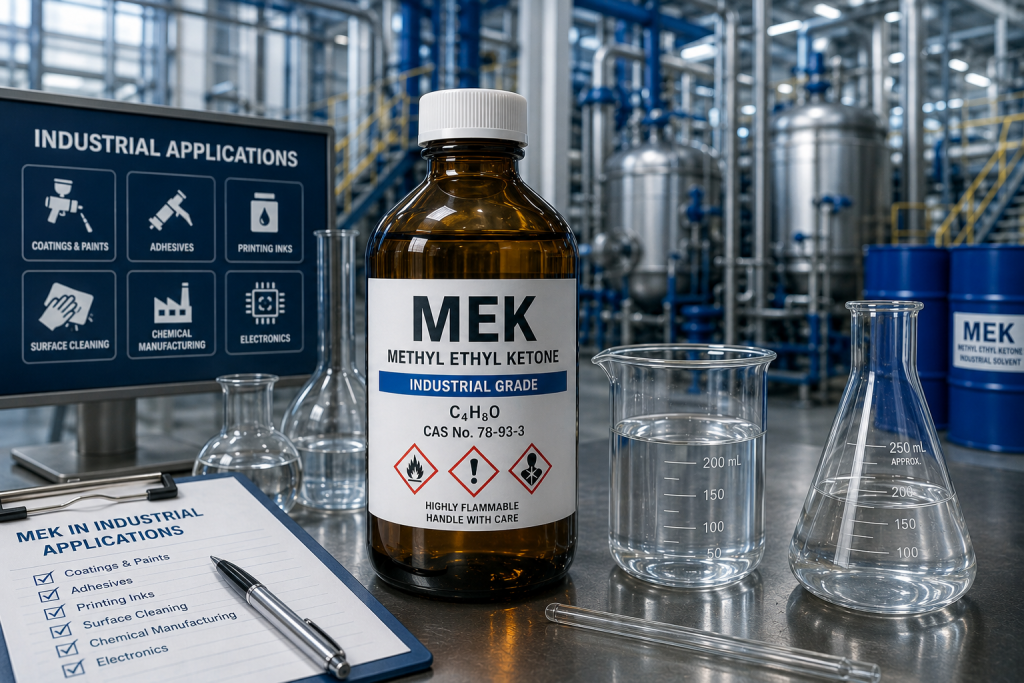
MEK (methyl ethyl ketone) is a fast-evaporating organic solvent used in coatings, adhesives, printing inks, surface preparation, and chemical manufacturing. Its solvency and drying characteristics make it useful in processes that require effective resin dissolution, controlled formulation viscosity, and efficient solvent removal.
This guide explains the technical properties of MEK, its major industrial applications, safety requirements, and comparison with alternative solvents. It also outlines the factors manufacturers should evaluate before selecting a suitable grade for their production processes.
What Is MEK?
Methyl ethyl ketone, also known as 2-butanone or butan-2-one, is a colorless, volatile liquid belonging to the ketone family. It is valued for dissolving many resins and polymers and for evaporating relatively quickly under typical processing conditions.
MEK is used in a range of industrial formulations, including selected coatings, adhesives, printing inks, and cleaning systems. Its suitability depends on the formulation, substrate, required drying profile, and applicable safety and environmental requirements.
MEK Technical Specifications
The following table provides a quick reference to commonly reported physical and chemical properties. Confirm the values against the supplier’s Technical Data Sheet (TDS) for the exact grade and test conditions before using them in process calculations.
| Property | Typical value |
|---|---|
| Chemical name | Methyl ethyl ketone |
| Synonyms | MEK, 2-butanone, butan-2-one |
| Molecular formula | C4H8O |
| CAS number | 78-93-3 |
| EC number | 201-159-0 |
| Molecular weight | 72.11 g/mol |
| Appearance | Clear, colorless liquid |
| Boiling point | Approximately 79.6°C at atmospheric pressure |
| Flash point | Approximately -9°C; method-dependent |
| Density | Approximately 0.805 g/cm³ at 20°C |
| Dynamic viscosity | Approximately 0.4 mPa·s at 20°C |
| Water solubility | Soluble in water; consult grade-specific references for quantitative values |
| Solvent characteristics | Volatile ketone with strong solvency for many resins |
These values are reference figures rather than a substitute for the manufacturer’s documentation. Temperature, pressure, purity, and the test method can affect reported properties, particularly flash point and density.
Why Is MEK Used in Manufacturing?
Manufacturers select solvents according to their ability to dissolve target materials, achieve the required drying time, and maintain consistent product quality. MEK offers several useful characteristics for compatible formulations and cleaning processes.
- Effective solvency: It dissolves many resins and polymeric materials used in industrial formulations.
- Rapid evaporation: Its relatively low boiling point supports quick drying in suitable applications.
- Formulation flexibility: It can be used in selected coatings, adhesives, and printing ink systems.
- Low viscosity: Its fluidity can support handling and formulation processes.
- Industrial availability: It is commercially supplied for a range of manufacturing requirements.
These properties do not make MEK suitable for every process. Manufacturers should confirm resin compatibility, substrate resistance, required purity, drying behavior, and workplace controls before changing a formulation or cleaning procedure.
MEK Industrial Applications
1. Paint and Coating Manufacturing
In compatible coating formulations, MEK can dissolve selected resins, adjust viscosity, and influence drying behavior. It may be used in industrial finishes, protective coatings, and other solvent-based systems where the formulation requires its particular solvency and evaporation profile.
Its relatively fast evaporation can help shorten drying stages, but the result depends on the complete formulation, film thickness, airflow, temperature, and application method. Excessively rapid solvent loss may affect flow, leveling, or film appearance if the formulation is not designed for it.
Before using MEK in a coating, test resin compatibility, application performance, final film quality, and compliance with relevant emissions requirements.
2. Adhesives and Sealants
Adhesive manufacturers may use MEK to dissolve compatible polymers and prepare solvent-based adhesive formulations. Its role depends on the adhesive chemistry, required viscosity, substrate, and bonding process.
In applications involving automotive components, furniture, footwear, packaging, or construction materials, formulation testing is essential. Drying rate, open time, adhesion strength, substrate resistance, and residual solvent levels may all affect the finished product.
A formulation should not be changed solely because a candidate solvent dissolves the main polymer. Compatibility with other ingredients and the complete application process must also be confirmed.
3. Printing Inks and Packaging
Some printing ink systems use MEK to dissolve compatible binders and achieve the required viscosity and drying behavior. Depending on the ink formulation and printing technology, these properties can support efficient transfer and drying during production.
Packaging converters and printing facilities should evaluate print quality, substrate compatibility, drying performance, emissions controls, and residual-solvent requirements. Applications involving food packaging may be subject to additional regulations and migration or residual-solvent specifications.
The correct solvent system depends on the ink chemistry and production equipment; MEK should not be assumed to be suitable for every printing application.
4. Surface Preparation and Industrial Cleaning
MEK can remove certain oils, grease, waxes, adhesives, and other residues from compatible surfaces. It may be used during surface preparation before coating, bonding, or other manufacturing steps.
Cleaning performance depends on the contaminant, substrate, solvent contact time, and cleaning method. The process should also account for flammability, vapor exposure, ventilation, and waste collection.
Where lower-hazard alternatives are available, compare their cleaning performance and total process cost before deciding which approach to use. Related information is available in our guide to industrial cleaning chemicals.
5. Chemical Manufacturing and Processing
Chemical manufacturers may use MEK as a solvent in selected formulations, processing steps, and specialty chemical applications. Its usefulness depends on the solubility of the target material, required process conditions, and downstream separation requirements.
Process engineers should assess chemical compatibility, solvent recovery options, product purity, and potential effects on subsequent production stages. Technical documentation and small-scale trials can help establish whether the solvent is appropriate for a specific process.
6. Equipment and Component Cleaning
MEK may be suitable for cleaning certain production tools, metal components, and equipment surfaces when the materials are compatible. However, it can damage some plastics, elastomers, coatings, and seals.
Before use, identify all materials that may contact the solvent, including hoses, gaskets, containers, and machine components. Confirm compatibility with the equipment manufacturer and follow the facility’s approved cleaning procedure.
For sensitive electronics or precision components, use only a solvent and cleaning method approved for the specific application. Residue requirements, component materials, and electrical safety considerations must be evaluated independently.
MEK Compared with Other Industrial Solvents
Manufacturers often compare MEK with other solvents when developing formulations or improving cleaning processes. No single solvent is best for every application; the decision depends on solvency, evaporation, compatibility, safety, regulatory requirements, and total operating cost.
| Solvent | Key characteristics | Common application areas |
|---|---|---|
| MEK | Strong solvency for many resins; relatively fast evaporation | Selected coatings, adhesives, printing inks, and cleaning |
| Acetone | Very volatile; useful for many cleaning and formulation tasks | Cleaning, coatings, and compatible laboratory processes |
| Toluene | Aromatic solvent with solvency for selected resins | Coatings, adhesives, and chemical formulations |
| Xylene | Aromatic solvent with a higher boiling range than MEK | Selected paints, coatings, and resin systems |
| Isopropyl alcohol (IPA) | Polar solvent commonly used for compatible cleaning applications | Surface cleaning and selected precision-cleaning tasks |
For further comparisons, read our guides to toluene uses in industry and isopropyl alcohol industrial applications.
How to Choose the Right MEK Grade
Different manufacturing processes may require different purity levels, documentation, packaging, and quality controls. Buyers should establish their technical requirements before placing an order.
Define the Application
Identify whether the solvent will be used for formulation, cleaning, extraction, or another process. Each application may require a different level of purity and different performance criteria.
Check Purity and Documentation
Review the product specification and request a current Technical Data Sheet and Safety Data Sheet. Where required, obtain a Certificate of Analysis for the supplied batch and confirm that the product meets the agreed specifications.
Test Compatibility and Performance
Run controlled tests using the intended resin, substrate, equipment, and operating conditions. Evaluate drying time, surface quality, cleaning efficiency, and any effects on materials that contact the solvent.
Evaluate Supply and Packaging
Consider packaging size, storage conditions, delivery requirements, batch traceability, and supplier consistency. For continuous production, reliable documentation and supply planning are important parts of procurement.
Safety and Handling Requirements
MEK is a highly flammable, volatile solvent. Its vapor can form flammable mixtures with air, and exposure may cause irritation or central nervous system effects. Safe use requires a documented risk assessment and compliance with the applicable regulations.
Facilities should review the current Safety Data Sheet and implement appropriate engineering and administrative controls. These may include suitable ventilation, ignition-source control, approved electrical equipment where required, safe transfer procedures, spill response planning, and employee training.
Use chemical-resistant gloves and other personal protective equipment selected according to the SDS and the task-specific risk assessment. Do not rely on protective equipment as a substitute for effective ventilation or other higher-level controls.
Relevant guidance is available from the U.S. Occupational Safety and Health Administration. Always follow local occupational safety, fire, storage, and transport requirements.
Storage Best Practices
- Store containers in a designated area suitable for flammable liquids.
- Keep containers tightly closed when not in use.
- Keep the product away from heat, sparks, open flames, and other ignition sources.
- Provide suitable ventilation and follow requirements for flammable-liquid storage.
- Use compatible containers and approved transfer equipment.
- Control static electricity where required by the transfer procedure.
- Maintain appropriate spill response materials and emergency procedures.
- Train workers in safe handling and review procedures periodically.
Environmental Impact and VOC Emissions
MEK is a volatile organic compound (VOC), so emissions management is an important consideration for many manufacturing operations. The applicable controls depend on the process, quantity used, facility location, and relevant environmental regulations.
Facilities may reduce solvent losses through closed transfer systems, well-maintained equipment, effective process controls, and suitable vapor management technologies. Emission measurement and recordkeeping may also be required under local rules.
Environmental decisions should consider the entire process, including worker exposure, waste generation, energy consumption, and the suitability of possible alternatives. Guidance and regulatory information are available from the U.S. Environmental Protection Agency and the European Chemicals Agency.
Solvent Recovery and Cost Optimization
Where technically and legally appropriate, recovering used solvent may reduce fresh-solvent consumption and waste generation. The feasibility of recovery depends on the composition of the waste stream, contamination levels, required recovered-product quality, energy use, and the cost of the equipment.
Before implementing a recovery system, manufacturers should evaluate separation performance, fire and explosion risks, quality-control procedures, and waste-handling requirements. Recovered material should be reused only when it meets the specifications of the intended process.
Learn more about this approach in our article on solvent recovery systems.
Industrial Demand and Supply Considerations
Demand for industrial solvents is linked to activity in coatings, adhesives, printing, chemical processing, and other manufacturing sectors. Purchasing requirements vary by country, industry, grade, and application, so buyers should assess their own consumption patterns rather than rely on broad assumptions about regional demand.
For businesses sourcing MEK in markets such as Iran, India, and Turkey, practical procurement considerations include product specifications, supplier documentation, applicable import and transport rules, packaging, lead times, and continuity of supply.
Manufacturers should compare offers on a consistent basis, considering delivered cost, batch quality, documentation, and technical support alongside the quoted price.
Where to Source MEK
Choosing a reliable supplier involves confirming chemical identity, grade, purity, packaging, and the availability of appropriate technical documentation. These checks help manufacturers maintain consistent process performance and reduce procurement risks.
Explore the AasadChimie product range or contact our team to discuss your industrial chemical requirements and product specifications.
Conclusion
MEK is an important industrial solvent for compatible coatings, adhesives, printing inks, cleaning operations, and chemical processing. Its solvency and relatively rapid evaporation can support efficient production when the formulation, substrate, and operating conditions are suitable.
Before choosing a product, review the technical specifications, test performance under representative conditions, and assess safety, emissions, compatibility, and total operating cost. Careful product evaluation and responsible handling help manufacturers maintain consistent quality while managing operational risks.
What is MEK mainly used for?
MEK is used in selected coatings, adhesives, printing inks, surface preparation, industrial cleaning, and chemical processing applications.
What is the chemical formula of MEK?
Its molecular formula is C₄H₈O, and its CAS number is 78-93-3.
Why is MEK used in coatings and adhesives?
It can dissolve compatible resins and provides a relatively fast evaporation rate. Its suitability depends on the formulation, substrate, and required performance.
Is MEK flammable?
Yes. MEK is a highly flammable liquid. It must be handled and stored with appropriate ventilation, ignition-source controls, and procedures based on the current Safety Data Sheet.
Can MEK be recovered and reused?
In suitable industrial systems, used MEK may be recovered and purified. Reuse depends on contamination, recovery quality, process specifications, and applicable regulations.
What documents should buyers request from a supplier?
Buyers should request a Technical Data Sheet (TDS) and Safety Data Sheet (SDS). A batch-specific Certificate of Analysis may also be required.