


Table of Contents
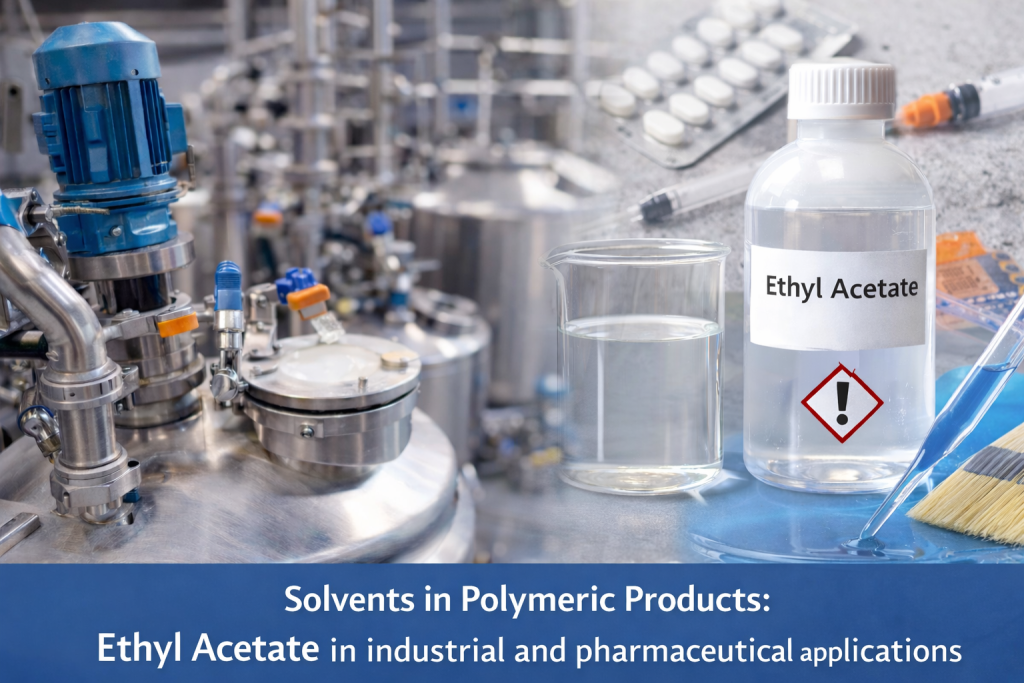
Ethyl Acetate is a widely used industrial and pharmaceutical solvent known for its versatility and efficiency. This solvent offers high solvency for polymers, resins, and various organic compounds, making it indispensable in coatings, adhesives, inks, and plastic manufacturing. Its rapid evaporation rate and relatively low toxicity contribute to both operational efficiency and safer handling.
Introduction to Ethyl Acetate
Ethyl Acetate (C4H8O2) is a colorless, volatile ester with a mild fruity odor. It is produced through the esterification of ethanol and acetic acid and is highly valued for its fast-drying properties and excellent solvency. In applications where performance and safety are critical, this ester is often the preferred choice.
Properties and Advantages
- Excellent solvency for polymers, coatings, and resins
- Fast evaporation for efficient production cycles
- Low toxicity for safer handling
- Environmentally favorable due to biodegradability
Industrial Applications
In industrial settings, this solvent is commonly used for coatings, paints, printing inks, and adhesives. Its ability to dissolve a wide range of polymeric materials ensures uniform application and smooth film formation. Controlled evaporation allows manufacturers to optimize production speed without compromising quality.
Pharmaceutical Applications
In the pharmaceutical sector, Ethyl Acetate serves as a solvent for extraction, purification, and formulation of active pharmaceutical ingredients (APIs). The ester’s low toxicity and clean evaporation make it suitable for capsules, coatings, flavorings, and fragrances, maintaining the quality and integrity of the final product.
Use in Polymer and Coating Industries
This solvent is highly effective in dissolving polymers and resins used in coating and adhesive applications. By adjusting viscosity and improving substrate adhesion, it ensures durable and uniform finishes. Its compatibility with various resins makes it an essential component in solvent-based polymer systems.
In addition to its use in coatings and adhesives, this solvent plays a critical role in the formulation of high-performance paints, varnishes, and sealants. It allows manufacturers to fine-tune the drying time, film thickness, and gloss levels of the final product, providing both aesthetic appeal and long-term durability. The solvent’s ability to uniformly disperse pigments and fillers ensures consistent color quality and surface smoothness, which is particularly important in automotive and industrial coatings.
Moreover, in adhesive technology, this solvent enhances the bonding strength of polymeric adhesives to a wide variety of substrates, including metals, plastics, and wood. It facilitates proper wetting of surfaces and reduces the risk of voids or bubbles in the adhesive layer. This leads to stronger, more reliable joints that meet stringent industrial standards for performance and longevity.
The solvent is also utilized in specialty polymer processing, such as the production of synthetic films, laminates, and composite materials. Its ability to dissolve complex polymer blends without degrading their mechanical properties makes it invaluable in research and development as well as large-scale industrial production. Additionally, the solvent contributes to improved coating flow, leveling, and adhesion on challenging substrates, enabling innovative product designs and functional surface treatments.
Finally, its relatively low toxicity, rapid evaporation, and environmental compatibility make it a preferred choice for industries aiming to comply with modern safety and sustainability standards. By integrating this solvent into polymer formulations, manufacturers can achieve superior performance while minimizing health risks and environmental impact.
Safety and Handling Guidelines
Although safer than many organic solvents, Ethyl Acetate is flammable and should be stored in cool, ventilated areas away from ignition sources. Workers must wear personal protective equipment (PPE) including gloves and goggles during handling. Industrial facilities often implement recovery systems to reduce emissions and improve environmental compliance.
Environmental Considerations
The ester’s biodegradability and low VOC emissions make it a preferred solvent for eco-conscious manufacturing. Many companies incorporate solvent recycling and emission control technologies to align with green chemistry standards, minimizing environmental impact while maintaining high process efficiency.
Laboratory and Research Uses
In laboratories, this solvent is used for extraction, chromatography, and sample preparation. Its strong solvency and rapid evaporation provide reproducible results, while its low toxicity reduces health risks for laboratory personnel.
Conclusion
Ethyl Acetate remains a key solvent in both industrial and pharmaceutical applications. By balancing high performance with safety and environmental considerations, this solvent supports a wide range of processes from coatings and adhesives to pharmaceutical formulations and polymer processing.
Thanks